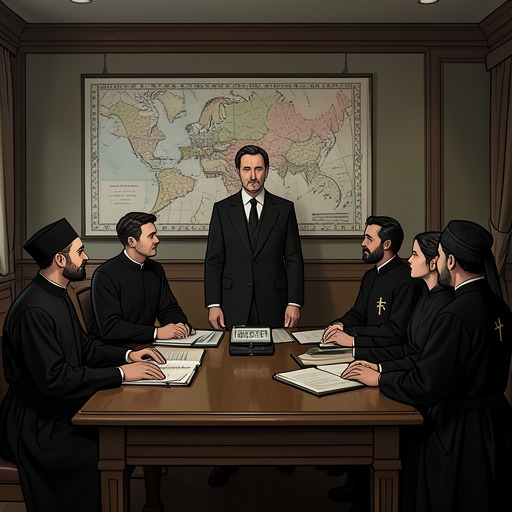
Roman Curia
Wolf HallThe Roman Curia is the papal administrative center at the heart of the novel’s struggle over jurisdiction, marriage, and royal authority. As Henry VIII seeks to end his marriage to Katherine of Aragon, the Curia is at once a destination for English diplomacy, a source of legal and spiritual judgment, and an obstacle to plans that would settle the king’s case within England.
The Curia and the King’s Suit
When Cardinal Wolsey considers sending Stephen Gardiner to Rome to sound out the Curia, Thomas Cromwell warns that the mission cannot remain secret for long. Papal spies, he says, would recognize Gardiner’s purpose while he was still preparing to leave, giving cardinals and secretaries time to set their prices. Cromwell advises that any envoy carry ready money: promises will not satisfy officials who need to placate their bankers. Wolsey jokes that Cromwell himself should go and offer Pope Clement a loan, recognizing his knowledge of financial markets.
The exchange frames Rome not as a remote abstraction but as a political and financial center whose response must be anticipated and negotiated. Cromwell’s account of the city’s influence is shaped by his experience there: he describes a place where the integrity of churchmen and officials may be tested by money and patronage. Wolsey cannot contradict him, though he has not experienced the same wariness in Rome.
Diplomacy, Law, and Competing Jurisdictions
Wolsey’s proposed approach is deliberately double. He intends first to convene a small court in London and confront Henry with the possibility that his marriage has been unlawful. If the king persists, Wolsey may seek to have the dispensation revoked either in England or in Rome. The Curia therefore matters not only as the authority that can be approached for a decision, but as part of a broader diplomatic calculation: Wolsey imagines that an annulment could permit Henry to marry a French princess and redirect England’s alliance against Charles V.
Cromwell, however, urges the king to begin proceedings within his own jurisdiction. He argues that a Roman mission would give the king’s desire an international airing before Henry has demonstrated that he truly intends to pursue it. The disagreement points to the novel’s larger conflict between papal and royal jurisdiction. Katherine maintains that her case is at Rome, awaiting the attention of the Holy Father, and refuses to recognize the English court at Dunstable. Cromwell answers that the king hopes to avoid excommunication and urges her not to foreclose a possible reconciliation. Their encounter makes clear that the Curia’s authority is not merely diplomatic: for Katherine, it is the legitimate forum for judgment on her marriage and the church’s standing.
A Changing Political Order
As Henry’s government advances claims of royal supremacy, Cromwell invokes Marsiglio of Padua’s propositions to argue that priests are subjects and that the Pope cannot grant secular rulers their authority. He presents Parliament as the legislative body through which the people’s will gives the king his kingship, and rejects Rome’s legitimate voice in England. This argument does not simply dismiss the Curia; it challenges the jurisdiction on which its authority in English affairs depends.
That challenge has practical consequences in the novel’s political world. Cromwell brings forward a bill to suspend payment of annates to Rome, using a division in the Commons to identify supporters and opponents. In another debate, he insists that Parliament can define the succession and that the country can be asked to endorse its settlement by oath. His claims meet resistance from those who consider spiritual jurisdiction beyond Parliament’s reach. The Curia thus stands behind a contest over who may make law, decide religious questions, and determine the limits of the English crown.
Narrative Significance
The Curia’s power is shown through both its distance and its entanglement in European affairs. Wolsey imagines its officials weighing money and political advantage; Cromwell treats its response as something to be managed through knowledge of finance and diplomacy; Katherine invokes its judgment as protection against an English process she regards as illegitimate. Meanwhile, Henry’s government works to make Rome’s authority in England increasingly contestable through legislation and public oaths.
These contrasting approaches give the Curia a continuing presence even when it is not physically before the reader. It is the institution to which Wolsey might appeal, the court Katherine awaits, and the external jurisdiction Cromwell’s political program seeks to displace. Its significance lies in how the marriage dispute becomes a test of sovereignty: the question is not only whether Henry’s marriage can be annulled, but whose authority can declare it so.